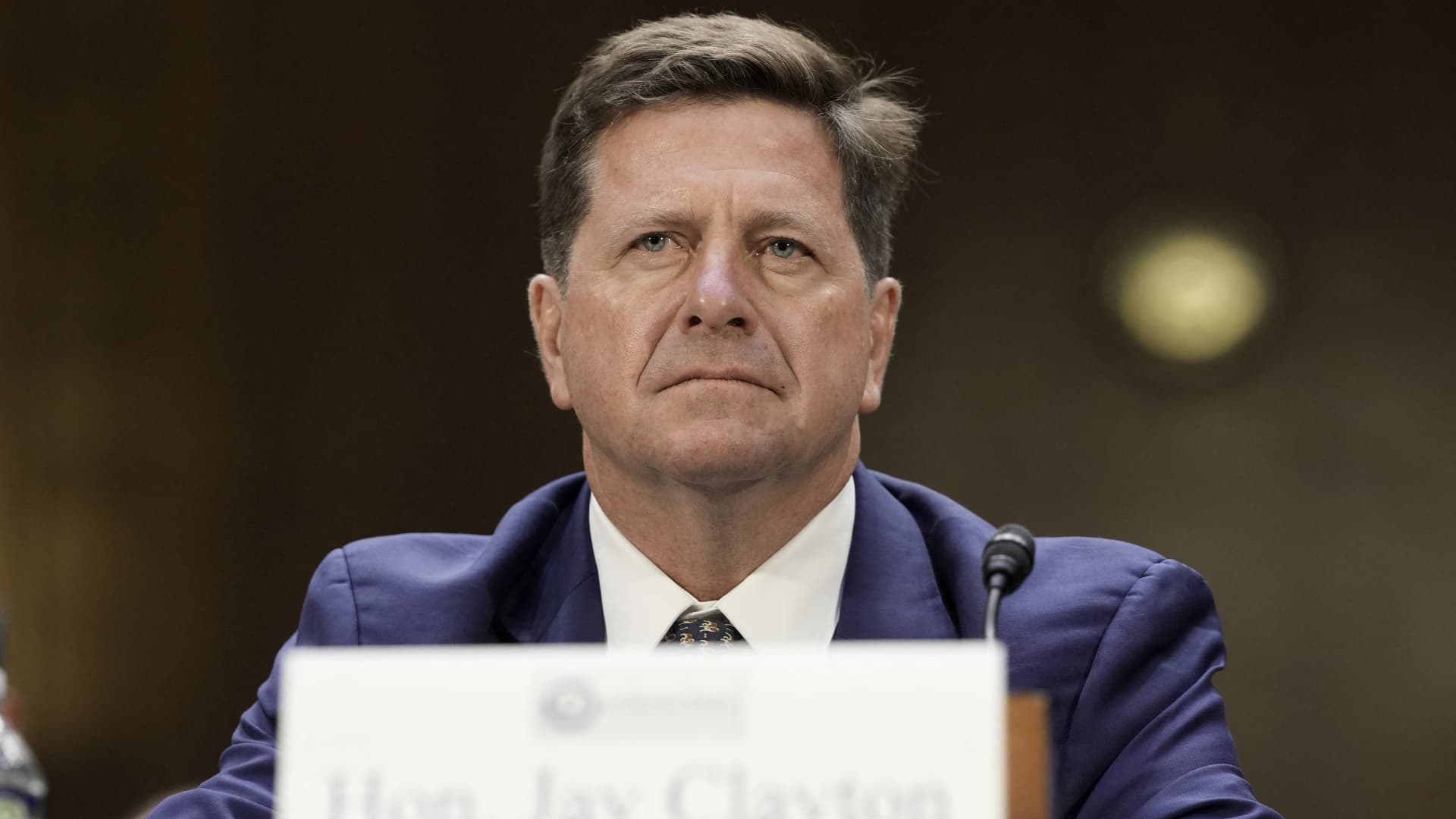
Jay Clayton, President Donald Trump’s nominee for director of national intelligence, repeatedly declined to state who won the 2020 presidential election and defended subpoenas of New York Times reporters during a contentious Senate Intelligence Committee hearing.
Jay Clayton, the former U.S. Securities and Exchange Commission chair and current U.S. attorney for the Southern District of New York, refused to explicitly state during his July 15 confirmation hearing before the Senate Select Committee on Intelligence that Joe Biden won the 2020 presidential election. Clayton also defended recent subpoenas issued to New York Times reporters and said he only recently learned of former DNI Tulsi Gabbard’s reported involvement in a raid of a Georgia election office.
Key moments from the hearing
- Election result question: When pressed multiple times about who won the 2020 election, Clayton avoided a direct statement. He said, “I am not an election denier. Joe Biden was certified,” but declined to answer in the plain terms senators sought.
- Tulsi Gabbard and Georgia raid: Sen. Jon Ossoff (D-Ga.) asked whether Clayton knew that his predecessor, Tulsi Gabbard, had taken part in a raid on a Fulton County, Georgia, election office earlier this year. Clayton said he only learned of Gabbard’s reported involvement from Ossoff during a private meeting earlier in the week and did not directly answer whether that conduct was appropriate for a DNI.
- Subpoenas of journalists: Senators pressed Clayton on subpoenas served to New York Times reporters after their reporting on security concerns involving an Air Force One gifted by Qatar. Clayton said he could not discuss investigative specifics but expressed confidence in procedures meant to protect the First Amendment and prevent intimidation of journalists.
Why It Matters
The director of national intelligence would oversee 18 agencies and receive access to the nation’s most sensitive intelligence. Clayton’s reluctance to clearly address whether President Biden won the 2020 election, his answers about election-integrity comments, and his role in issuing subpoenas to reporters raised concerns among Democrats about his judgment and independence—issues central to trust in the intelligence community and to congressional oversight.
Context & Background
- Nomination timeline: Trump announced Clayton’s nomination in June. Clayton’s initial hearing was postponed after Trump directed him not to appear. In the interim, Trump appointed Bill Pulte as acting director of national intelligence; Pulte has since removed dozens of senior intelligence officials, prompting bipartisan scrutiny.
- Section 702 and legislative friction: Trump had tied Clayton’s earlier hearing to negotiations over renewing Section 702 of the Foreign Intelligence Surveillance Act, seeking to press Congress to attach an election-related bill that would impose voter ID and citizenship-verification rules to the foreign surveillance renewal. Those negotiations later collapsed and the surveillance program lapsed in June.
- Prior public comments: Senators referenced Clayton’s June comments on CNBC’s “Squawk Box,” where he said the U.S. has “a deep problem with voting in America” and that the nation’s audit trails in some places fall short of expectations. Clayton told Sen. Angus King (I-Maine) that, without better processes, “we can’t say definitively whether there is, or is not” voter fraud.
Leadership and independence concerns
Senate Intelligence Committee Vice Chair Mark Warner (D-Va.) said he could not recall a prior instance in which the White House urged a committee to expedite a nominee and then blocked that nominee’s appearance. Clayton’s answers prompted sharp critiques from Democrats who described his testimony as lacking credibility and, in some cases, “disqualifying.”
Key questions raised by Democrats
- Would a DNI oversee domestic search warrants at sensitive election facilities?
- Did Clayton know of and how did he respond to reports that his predecessor participated in law-enforcement actions at an election office?
- Are the subpoenas of New York Times reporters consistent with First Amendment protections and standards for press treatment in criminal investigations?
Key Quotes
- On the 2020 result: “I am not an election denier. Joe Biden was certified,” Clayton said when asked whether Biden won the 2020 election.
- On press protections: “I am confident that the procedures that we have in place to protect the First Amendment and protect the freedom of the press, and not result in intimidation of journalists,” Clayton said regarding the subpoenas.
- On the nomination pause: Sen. Mark Warner noted the unusual circumstances surrounding the nomination, saying the committee had never faced a similar situation where the White House both pushed to move quickly and then halted the nominee.
What’s Next
The Senate Intelligence Committee is scheduled to vote on Clayton’s nomination next week. If the committee advances the nomination, the full Senate will consider confirmation. Clayton remains likely to secure confirmation in the Republican-controlled Senate, despite Democratic objections during the hearing.
Bottom Line for Traders
While this confirmation process involves national security leadership and political governance rather than market-moving corporate events, the hearing highlights continued political friction over intelligence oversight and press-protection issues. Those governance and political risks can affect investor sentiment in sensitive sectors—especially defense, cybersecurity and surveillance—if they translate into operational changes at agencies that oversee or contract with those industries.
Source: StockMarketLoop