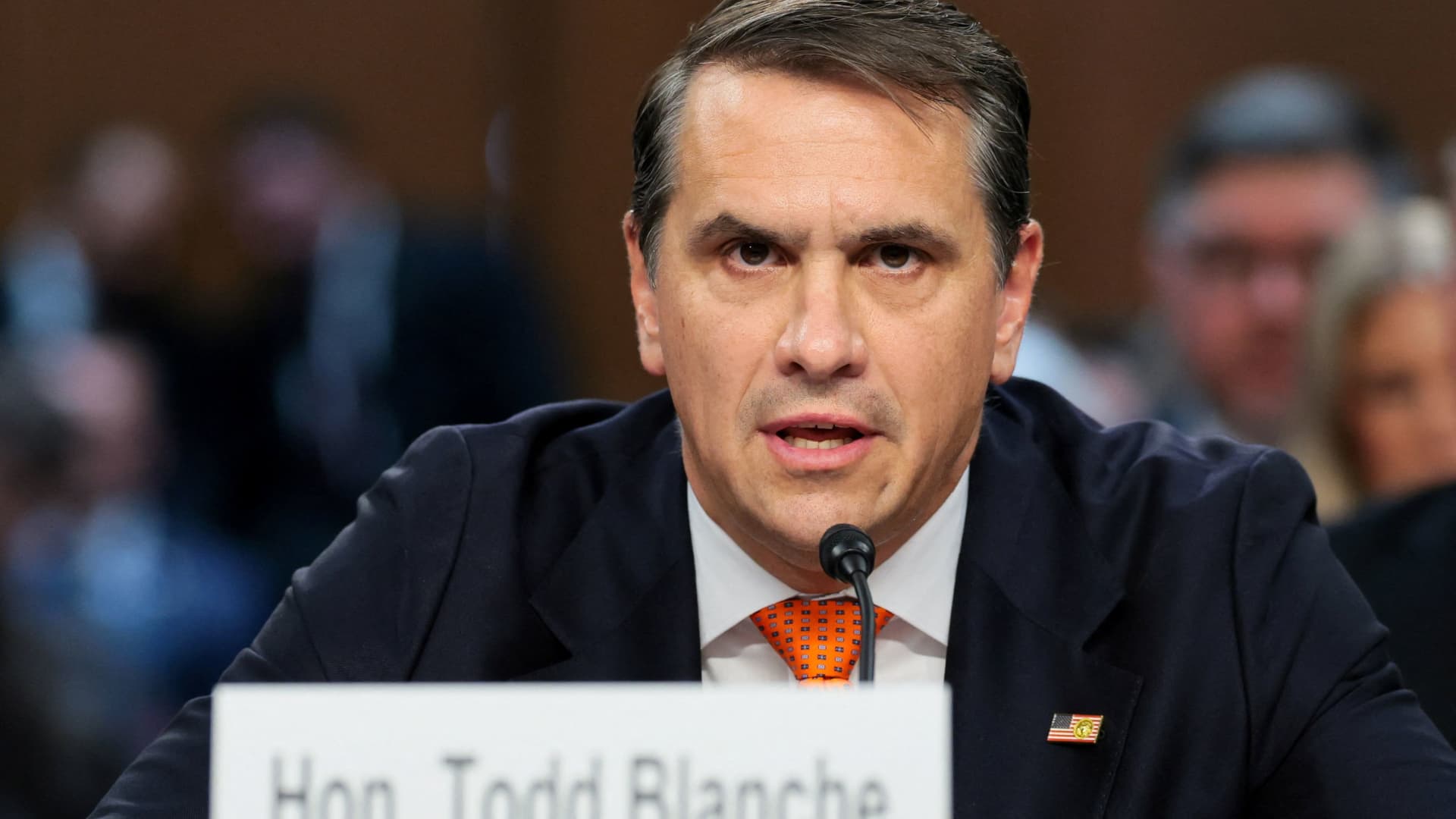
Acting Attorney General Todd Blanche faced intense Senate Judiciary questioning on July 15 over the Jeffrey Epstein files, a proposed $1.8 billion anti-weaponization fund and his prior crypto holdings — and publicly backed FBI Director Kash Patel.
Acting U.S. Attorney General Todd Blanche testified before the Senate Judiciary Committee on July 15 as lawmakers probed his nomination to become permanent attorney general. The two-day confirmation hearing focused on the Justice Department’s handling of the Jeffrey Epstein documents, Blanche’s aborted $1.8 billion “anti-weaponization” fund, and potential conflicts related to his cryptocurrency holdings. Blanche also publicly expressed “full faith” in FBI Director Kash Patel amid sharp questioning from senators.
Why It Matters
Blanche, who has served as acting attorney general since early April after President Trump dismissed Pam Bondi, told senators the Justice Department and the FBI worked “hard” to review and release responsive Epstein-related documents after a law last fall required disclosure. His testimony matters to investors and legal observers because the attorney general sets enforcement priorities, oversees high-profile prosecutions, and leads the DOJ’s relationship with the FBI.
Market Reaction
The original source did not provide market-price moves or ticker information tied to the hearing. No live market data was supplied.
Key exchanges and questions
- Sen. Sheldon Whitehouse (D‑R.I.) sharply criticized FBI Director Kash Patel and challenged Blanche directly: “How long do you intend to put up with that Kash Patel character?” Whitehouse questioned Patel’s travel, use of the FBI director’s jet, and whether Patel was fit for the role, including raised concerns about possible drinking on duty and personal travel disguised as official trips.
- Blanche responded to Whitehouse by calling the line of questioning “an extraordinarily obnoxious question,” then affirmed, “I have full faith in Director Patel and the work that he’s doing every day.”
- Blanche also faced questioning from Sen. Dick Durbin (D‑Ill.) about his cryptocurrency holdings and a 2025 decision, when Blanche was deputy attorney general, to dismantle the DOJ’s crypto enforcement team and halt certain criminal probes into the crypto industry. Durbin raised the prospect of a conflict given Blanche’s reported crypto assets and related family transfers.
Epstein files: scope, redactions and mistakes
Blanche described the department’s effort to comply with the recent law requiring public release of DOJ materials related to Jeffrey Epstein as a “Herculean task” involving review of millions of potentially responsive files. He said some documents were withheld because they were not responsive to the statute (for example, materials pertaining to a different person named Epstein), duplicates across investigations, or subject to legal privilege.
Blanche acknowledged redaction errors in the released files. He said roughly 1% of redactions needed fixing and that, when the department discovered that victims’ names were improperly unredacted, the DOJ removed those documents and corrected the materials “as soon as we could.” A group of Epstein victims has urged the Senate to block Blanche’s confirmation, saying the DOJ’s release exposed personal information that should have been redacted.
Anti‑weaponization fund controversy
Blanche was pressed on a proposed $1.8 billion “anti-weaponization” fund he announced as part of an out‑of‑court settlement tied to a lawsuit President Trump filed against the IRS over leaked tax records. Blanche said he canceled the fund after bipartisan criticism from senators. He told Durbin in a private meeting that he “made a mistake” and did not want the fund to move forward; Durbin said Blanche offered to work with Congress to codify that the fund cannot be created. Blanche has publicly stated the fund will not be established, although the president has suggested reviving the idea.
Cryptocurrency holdings and conflicts of interest
Durbin told reporters that after a private 30‑minute meeting, Blanche disclosed about $160,000 in cryptocurrency holdings that he had been instructed to divest. Durbin said Blanche described transferring holdings to family members. The senator characterized Blanche’s past actions—specifically, pauses in crypto enforcement—as raising potential conflict-of-interest concerns given Blanche’s financial ties to crypto assets. Blanche did not directly respond to Durbin’s public characterization during the hearing, though aides said Blanche consulted ethics officials and the Office of Legal Counsel.
Other oversight topics
Senators also raised questions about the Eastern District of Virginia prosecutions last fall — cases of particular interest because former defendants include individuals President Trump views as political adversaries, such as ex‑FBI Director James Comey and New York Attorney General Letitia James. Those cases were dismissed by a judge after concluding the interim U.S. attorney who lodged charges was invalidly appointed.
Leadership / Corporate Governance
Throughout the hearing Blanche emphasized the department’s professional review processes, defended the quality of DOJ and FBI reviewers, and accepted responsibility for mistakes in redactions. President Trump posted praise for Blanche on Truth Social, urging Republican senators to confirm him.
What’s next
The hearing continued across two days with additional questioning expected. Senators will weigh Blanche’s record on document handling, department priorities, and potential conflicts before deciding on confirmation.
Key Quotes
- “We worked hard, hardworking lawyers within the department, to do the right thing, and we will continue to do so,” Blanche said regarding the Epstein files.
- “Whenever we learned that any victim’s name had been improperly not redacted, we immediately took the document down and fixed it as soon as we could,” Blanche testified.
- Sen. Whitehouse: “Are you willing to look at whether he [Patel] lied to this committee?”
Bottom Line for Traders
This hearing centers on legal and governance issues at the Department of Justice and the FBI, not on market-moving economic policy. Still, the attorney general’s confirmation could affect enforcement priorities, regulatory approaches to technology sectors including cryptocurrency, and high-profile litigation that has secondary effects on legal services, compliance industries, and firms tied to DOJ investigations. The source does not provide market prices or ticker moves.