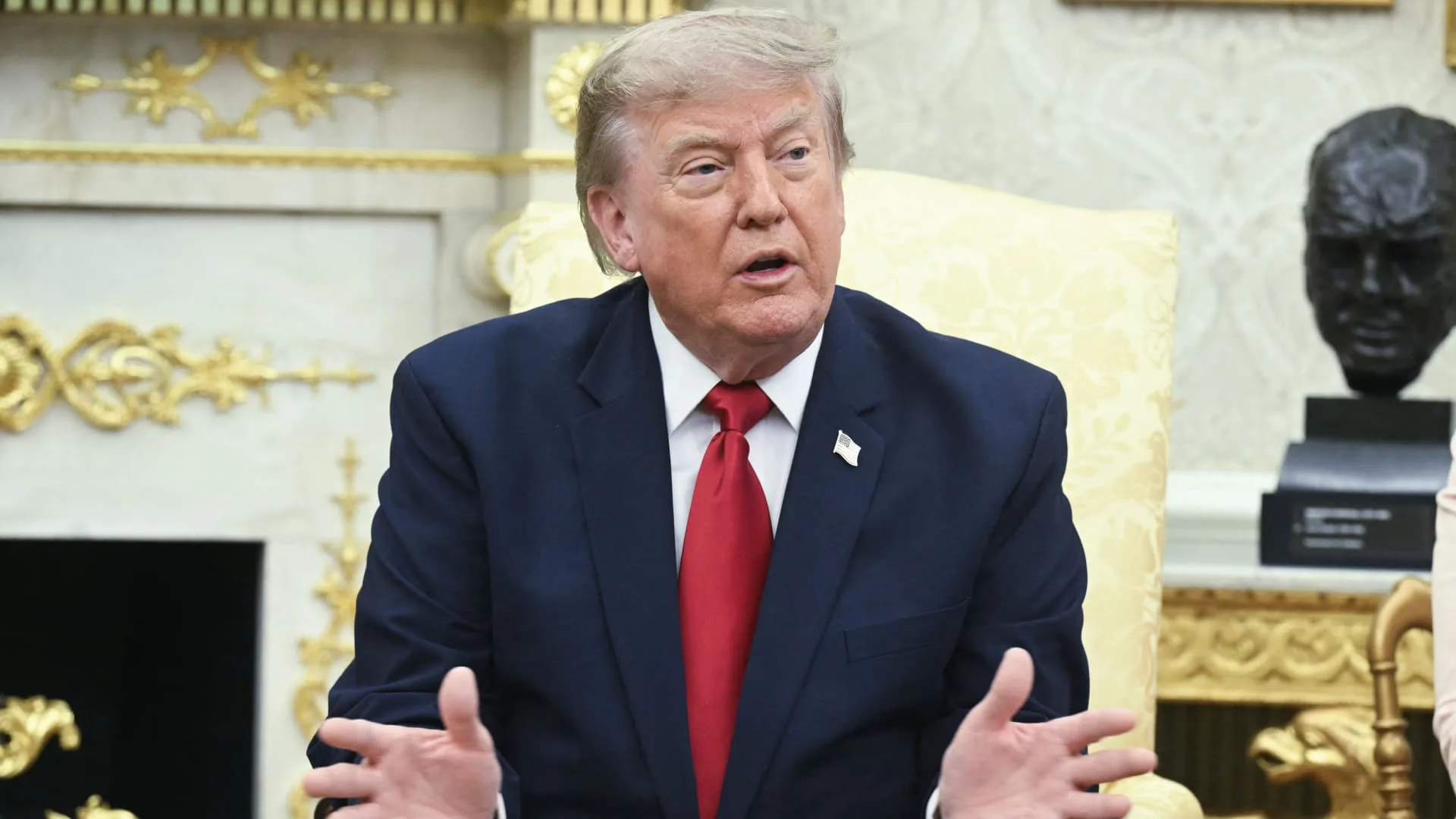
President Trump said Iran “wants to meet” even as U.S. Central Command reported a second round of strikes targeting Iranian military sites tied to threats in the Strait of Hormuz; analysts warn the conflict risks becoming prolonged.
U.S. President Donald Trump said on Wednesday that Iran has expressed a desire to meet and negotiate, while U.S. forces launched a second wave of strikes against Iranian targets within 12 hours. The actions — and Trump’s repeated threats to target Iranian infrastructure next week — deepen a confrontation that analysts say carries a risk of a drawn-out conflict.
Intro
Trump told Fox Business that he received word Iran “wants to meet” as he prepared for a roundtable on defense and innovation. At the same time, U.S. Central Command (CENTCOM) posted that at 3 p.m. ET its forces “launched operations for a second wave of strikes today against Iran,” saying the strikes targeted Iranian military capabilities used to threaten vessels transiting the Strait of Hormuz. CENTCOM earlier said precision munitions struck coastal defense systems and cruise missile storage and launch sites on Greater Tunb Island during a separate strike that began about 6 a.m. ET and ended at 7:30 a.m. ET.
Market Reaction
Energy markets showed sensitivity to the unfolding events. The report stated front-month Brent crude futures were holding above $85 per barrel amid ongoing concerns about safe passage through the Strait of Hormuz, a critical global oil shipping route.
Iran’s public posture
Iranian leaders have presented a posture of readiness for combat while leaving the door open to diplomacy. Parliamentary speaker Mohammad Bagher Ghalibaf, quoted in state media, said Tehran “has never welcomed war” but must be prepared for battle and continue to “use the tools of diplomacy and negotiation to achieve and solidify our national interests.”
Escalation timeline
CENTCOM’s strikes follow prior U.S. operations earlier in the week, and Tehran has responded with attacks on several Gulf states. Trump had warned that strikes would intensify if Iran did not engage in talks; in interviews he has repeatedly said U.S. forces would “hit them very hard” and specifically threatened to target Iranian power plants and bridges next week unless Tehran returns to negotiations.
Policy moves and messaging
Earlier this week Trump floated imposing a 20% levy on cargo moving through the Strait of Hormuz but subsequently dropped that demand, saying Gulf states would invest in the U.S. as compensation. Observers say the shifting public messaging complicates risk assessments for shipping and regional actors.
Expert analysis: risk of a prolonged conflict
Commentators and analysts cited in the report say the situation shows little immediate path to settlement. Mike Rosenberg, management professor at IESE Business School, argued that past agreements were unrealistic and predicted negotiations will be difficult; he suggested any durable deal may resemble prior joint action frameworks and could be politically hard for the administration to accept. Andreas Böhm, a Middle East affairs lecturer at the University of St. Gallen, warned the conflict could become a long-running, low-level war if neither side can find a face-saving exit, and said broad strikes on Iranian infrastructure risk reciprocal hits to Gulf energy assets.
Why it matters
The strikes and public threats target sites Tehran uses to influence maritime security in the Strait of Hormuz, a chokepoint for global oil shipments. Disruption or escalation in that area typically raises oil-market volatility and increases maritime-security costs, with knock-on effects for global trade and regional insurance and shipping routes.
What’s next
The report states U.S. forces have already conducted multiple strike rounds in recent days and that the president signaled further operations could target critical Iranian infrastructure next week if diplomacy does not progress. Iranian official statements maintain both readiness for combat and a willingness in principle to use diplomacy, leaving outcomes uncertain.
Key quotes
- President Donald Trump: “They want to meet… They’re nasty people, but they want to make a deal.” (Fox Business interview)
- CENTCOM (post): “The strikes are targeting Iranian military capabilities used to threaten vessels freely transiting through the Strait of Hormuz.”
- Mohammad Bagher Ghalibaf (Iran’s parliamentary speaker): “We have never welcomed war, and we will not, but we must always be prepared for battle… we must also use the tools of diplomacy and negotiation…”
Bottom line for traders
Source-supported details in the report indicate rising geopolitical risk concentrated on the Strait of Hormuz. Analysts cited in the article see no clear short-term resolution; traders and market participants often react to such risk with higher energy-price volatility, increased shipping and insurance costs, and shifts in safe-haven demand. The article does not provide price-by-price trading guidance or live market data beyond reported Brent futures levels.
Source: StockMarketLoop